



Imagine yourself as a supervillain. Not a sad underachiever like Voldemort, who couldn’t even take over a school, but someone like Palpatine or Sauron. What do they have in common (besides obvious mental health issues and a love for lightning, fire, and vaguely phallic symbols — lightsabers and very, very large towers)?
They approached things systemically. They built infrastructures instead of chasing some scrawny teenager around.
So when we talk about how to make knowledge and expertise more accessible, more engaging, and actually impactful, we’re not going to chase the boy with a scar (his time will come when we get to content, language, and all that — in some other piece).
Instead, let’s talk about systemic and infrastructural solutions that can help organizations, sectors, expert institutions, and universities work with new knowledge and audiences more effectively and deliberately.
In his article The Research Industry Faces Its Innovator’s Dilemma, Ibukun Taiwo writes:
Essentially, knowledge creation centers must evolve into knowledge sharing and decision-support entities. Their future relevance depends on whether they can become high-leverage distribution and decision infrastructure. This means treating Packaging, Distribution, Adoption, and Consumption not as afterthoughts, but as design problems, each requiring its own logic, incentives, and skill sets. Often this won’t look elegant. It will look like stitching pieces together until ideas actually move and decisions shift. But that is how change happens in the real world.
I fully agree with this. And this applies regardless of the audience or the type of impact we are talking about.
Whether the audience is policymakers and decision-makers, funding organizations making allocation decisions, or broader public audiences, the challenge remains the same: not just producing knowledge, but making it move to where it can change something.
The lifecycle of knowledge (if you care about more than just producing it)
If we look at any piece of knowledge or expertise, it doesn’t just appear and exist. It moves through a series of stages:
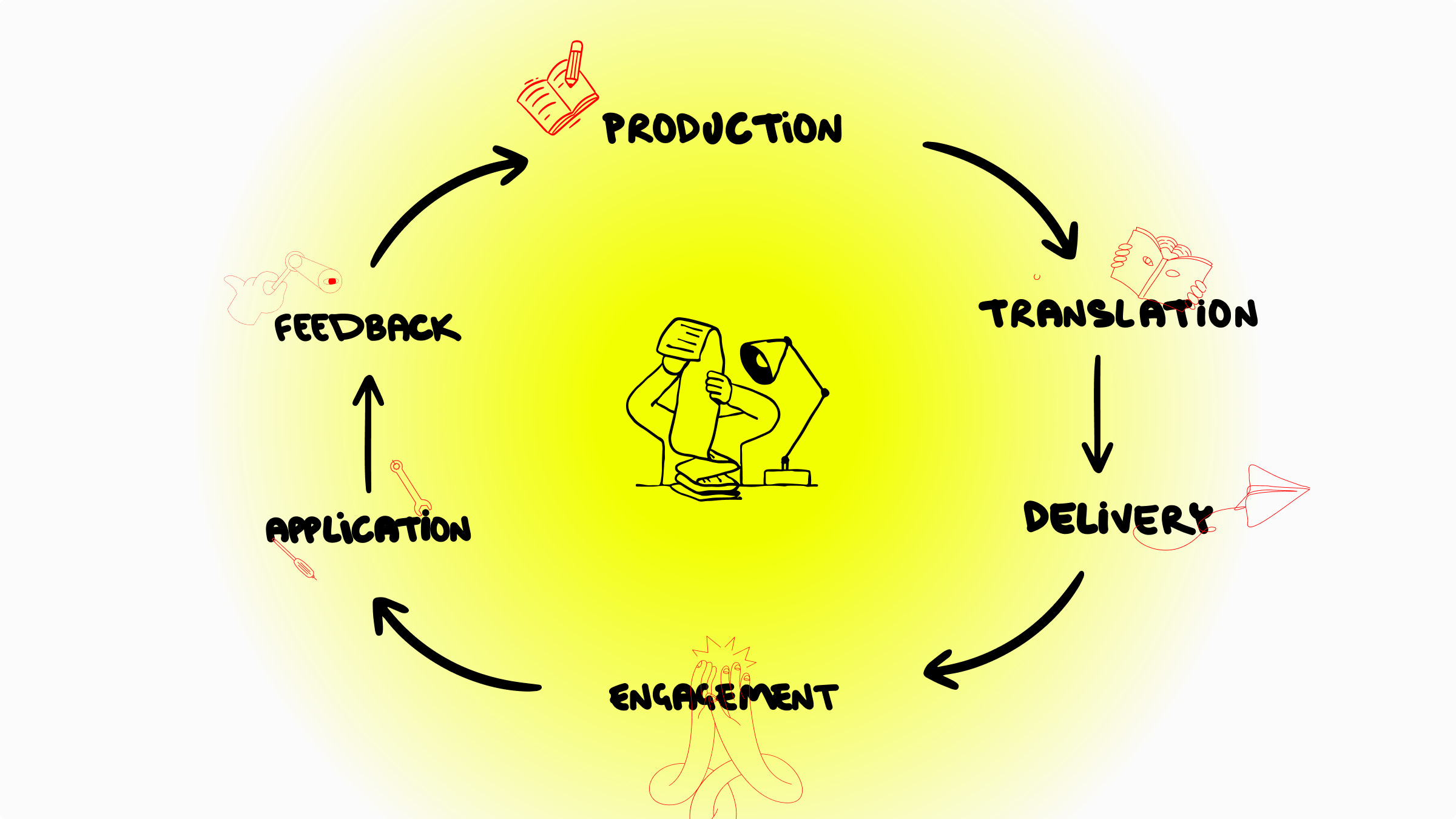
A lifecycle of knowledge begins with production — the creation of new knowledge (research, insights, and expertise). This knowledge is then translated: interpreted, broken down, reframed, and grounded in context and experience so that it becomes understandable and related for different audiences.
From there, it moves into delivery, where it is structured and distributed through appropriate channels, formats, and moments of use. Engagement follows, as people interact with it: recognizing its relevance, connecting it to their own reality, and understanding what it might change.
Then the application stage - when knowledge enters decisions, processes, projects, and actions.
Then feedback stage - as a complex return of experience: what individuals tried and struggled with, how institutions used (or failed to use) the knowledge, what constraints made application difficult, how ideas were adapted or reinterpreted, where they failed, and what unexpected effects appeared.
This feedback feeds into renewal — refining, expanding, or challenging the original knowledge and starting the cycle again.
Platform-based approach
Let’s first define what a platform means in this context.
A platform is an operational system that carries knowledge through its full lifecycle — from production to translation, delivery and engagement, to application, feedback, and continuous renewal.
It is a system that combines several elements:
1. Infrastructure: The underlying systems that make knowledge persistent, accessible, and connected: digital platforms (websites, databases, repositories), content management systems, and so on.
2. Processes. The ways knowledge is created, translated, distributed, and updated over time: research and knowledge production workflows, translation and adaptation pipelines, feedback collection, and iteration cycles
3. Formats. The forms through which knowledge is shaped and delivered to different audiences: reports, articles, explainers, visualizations, toolkits, templates, events…
4. Interactions. The ways people engage with knowledge and with each other around it: discussions and comments, surveys and interactive content, collaborative work (e.g. workshops, co-creation)
All these elements are connected through three principles:
1. Alignment. All elements (knowledge production itself, the content derived from it for different audiences, formats, events, tools, and more) are aligned around a shared strategic focus.
2. Differentiation. Knowledge is not delivered as a single stream, but translated and structured for different audiences. Different entry points, formats, and infrastructure elements are designed for different groups (professionals, institutions, policymakers, and broader publics).
3. Integration. Infrastructure and the rest of the ecosystem are not separate layers. Content, engagement, tools, and applications are connected, creating a continuous environment rather than a set of isolated outputs.
A platform-based approach is a practical response to a core challenge of modern knowledge industries: reaching relevant audiences and becoming part of their decisions and actions.
Types of platforms
There are platform-based solutions that cover parts of this lifecycle, and that alone is a significant achievement, requiring substantial effort and coordination.
1. Knowledge Production Platforms, where knowledge is created and circulates within expert communities
Platforms that accelerate the production of knowledge and make it accessible within professional communities, effectively covering the Production phase and partially the Feedback phase. Here are some examples:
ArXiv. An open-access repository for preprints in physics, mathematics, computer science, and related fields. ArXiv accelerates the production and circulation of knowledge before formal publication.
SSRN. A global repository for early-stage research in social sciences, economics, law, and the humanities. It enables rapid dissemination of working papers and ideas, allowing knowledge to circulate, be discussed, and evolve within expert networks before formal institutional validation.
And of course, ResearchGate and GitHub.
2. Translation Platforms, where knowledge becomes understandable
Platforms that break down complexity, adapt knowledge for different audiences, and construct (or support the construction of) narratives. They operate primarily across the Translation and Delivery phases.
Our World in Data. A platform that transforms academic research and datasets into accessible explanations and interactive visualizations on global issues. OWID translates complex data into structured narratives and visual formats, making it understandable and usable for media, policymakers, and the public.
The Conversation. A publishing platform where academics write for a general audience, supported by editorial teams.
Vox / McKinsey Global Institute. Editorial platforms and research units focused on explainers, deep dives, and synthesis of complex topics. They take fragmented or technical knowledge and turn it into coherent narratives, helping audiences understand not just what is happening, but why it matters.
3. Engagement and Feedback Platforms, where knowledge meets its audience and is reshaped through interaction
Platforms that create interaction, enable participation, and generate feedback. These are ecosystems where the audience is no longer just a recipient of knowledge, but becomes a contributor through discussion, problem-solving, and distributed input. They primarily operate in the Engagement and Feedback phases.
Zooniverse. A citizen science platform where volunteers help researchers process and classify large datasets. Engagement here is not just interaction; it contributes to research outcomes.
Culturalist.fi. A media and engagement platform within a research-driven expert organization, combining content, events, and interactive formats for a general audience (Russian-speaking immigrants in Finland). Included here as a first-hand case: developed and operated within Cultura Foundation, where I am directly involved in building and evolving the platform.
4. Application Platforms, where knowledge becomes actionable
Platforms that turn knowledge into tools, embed it into workflows, and directly influence decisions. They operate primarily in the Application phase. Party-affiliated think tanks may operate closer to the application layer, especially when they are directly involved in policy design and decision-making processes.
Cochrane Library. A collection of systematic reviews and evidence summaries used in healthcare decision-making.
Climate-ADAPT. A platform supporting climate adaptation planning across Europe, providing data, case studies, and decision-support resources.
Platform of the full cycle — utopia or strategy?
Can you build a platform with infrastructure, processes, formats, channels, and projects around it that actually covers the full lifecycle of knowledge within one organization (or, if you’re feeling ambitious, an entire field)?
Maybe. Hard to say. If you’ve seen it done properly, I’d like to see it.
But in practice, that’s not how it works. No one builds the full system at once. It’s always iterative. Most organizations already operate somewhere in this lifecycle. You don’t “launch a platform”, you build and connect parts of the cycle, adding missing layers over time.
In many organizations, the first part already works: production → translation → delivery.
Research is produced, turned into content, and distributed through platforms and channels. Editorial practices adapt knowledge for different audiences. Formats evolve. Collaborations extend reach.
The next step is delivery → engagement. Knowledge needs to become interactive. This includes interactive content, events as conversations, community or panels development, co-design formats, and feedback loops. Different audiences require different formats. There is no single “engagement layer”.
The hardest transition is engagement → application. To move forward, knowledge needs to become usable: tools, playbooks, frameworks. It needs to enter real contexts through working groups, partnerships, and direct work with organizations, institutions, and policy-makers.
Finally, feedback, and the key is not just collecting it, but integrating it back into research, workflows, and decisions.
Let’s wrap this up
First, I promise this is the last piece of this size. But it felt important to articulate the framework behind a platform-based approach.
We’re not Voldemorts obsessing over what kind of wood our wand is made of. If we want anything resembling systemic development, we need to think and act strategically.
That means being a bit more like Palpatine (without getting carried away, and remembering it took him years to build anything), and like Sauron — building systems: infrastructures, collaborations, side projects, and initiatives, all connected by one thing — a drive for influence and change.
Related articles ↓

