


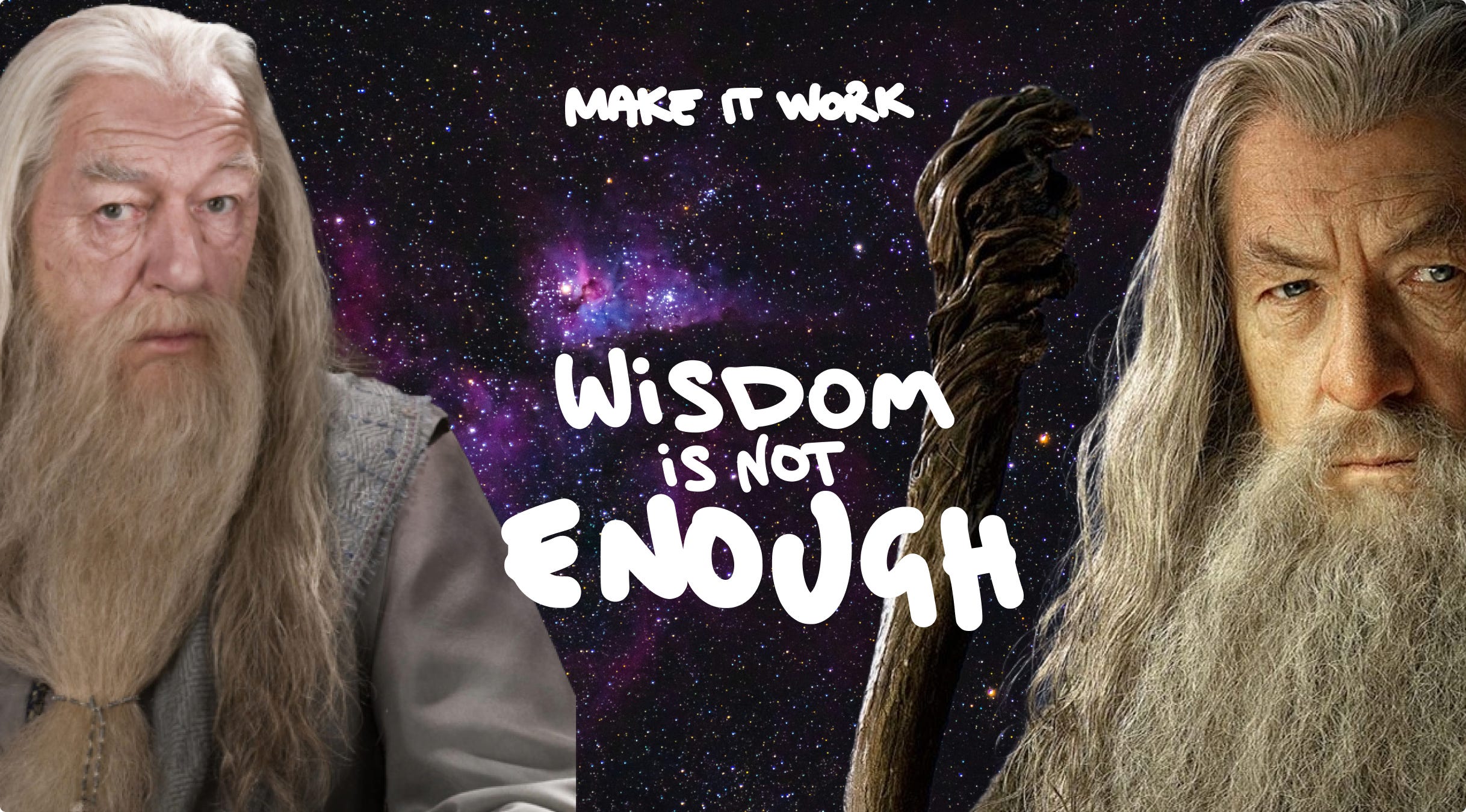
You know, Dumbledore always annoyed me a bit.
A carrier of ultimate wisdom, deep knowledge, and the most important secrets across seven books and eight films - and not once did he manage to actually explain any of it in a way that led to conscious action. Manipulating a child doesn’t count!
His problem (besides the whole manipulative mindset, which isn’t today’s topic) is simple: he couldn’t translate knowledge. He couldn’t explain things in a way that even Harry (already exhausted from messy, unstructured school learning) could actually understand and relate to.
And Harry (we assume) is his key audience. The one whose decisions and actions Dumbledore supposedly wants to influence.
Most of the knowledge we produce never becomes anything
Dumbledore reminds me of most companies and organisations built around knowledge and expertise.
We run research (academic or applied), we formulate our expertise, we build projects based on new knowledge, and launch initiatives meant to create change — inside a business, within an organisation, or in the outside world.
And we expect them to work.
This happens across expert organisations, research institutions, and knowledge-intensive businesses — anyone who, in one way or another, produces new knowledge.
It gets published, shared, sometimes even discussed, but rarely used. And even more rarely does it lead to the kind of change it was supposed to create.
Very often, new knowledge simply doesn’t reach the people it was meant for, doesn’t inform decisions, and doesn’t lead to change in organisations, in industries, or in society.
I’ve been working close to this gap for years (across research, media, and public initiatives). And the more I see it, the clearer it becomes: the problem is not knowledge itself. It’s everything around it.
In the end, every respectable organisation, research institute, or consulting company has a special section on a website, filled with an endless graveyard of long, multi-page PDFs.
And I want to explore, together with you, what makes knowledge actually usable when everything around it is unstable, incomplete, and under pressure.
The PDF Graveyard and Vague Explanations
There’s a whole class of explanations we fall back on when new knowledge (solid research, real expertise, something genuinely valuable) goes unnoticed and leads nowhere:
“People don’t read anymore”
“No one is interested”
“We need better communication” (whatever that means)
“Our audience is too small” or “This is not for everyone”
“We’re too complex / too niche”
And my personal favourite (perfectly phrased despair!):
“If even one person sees this (the one who truly needs it!)
that’s already success.”
This is a real line I once heard in a conversation with a former colleague!
We tell ourselves we just need to “explain better” or “get more reach.” But communication (at least in this simplified sense of polishing texts and chasing visibility) is not the problem. Or only a very small part of it.
When you work in resource-constrained environments, in small teams, this becomes even more visible.
We invest time and effort into producing knowledge, often assuming (arrogantly, and short-sightedly), that the mere fact that it is useful, important, and uploaded as a PDF on a website is already enough.
Or, at least, that's what happens next is no longer our responsibility.

Make it different
Let’s pause the broader idea of knowledge translation for a moment and talk about a few core principles I see (and try to implement in practice) that are necessary for knowledge, research results, and collective or individual expertise to become not just more accessible, but understandable and usable for target audiences.
1. Repetition is Your New Magic
We often talk about clarity. Much less often, about the fact that any knowledge, expertise, or complex information requires repetition and consistency.
If a better explanation were enough, most of this would already work.
Anything complex should be formulated simply: in one sentence — great. In two — still great. In a short, clear paragraph — also fine.
And it is exactly this paragraph that needs to be communicated everywhere, constantly, repeating it almost word for word for each target audience.
Without getting distracted by details, complexity, or our constant urge to add something more (you will always have a chance to expand later — but only when the person, the audience, moves further along the funnel of understanding and working with the information).
A large sociological study? One sentence — what the study is about. Second — the key finding. Third — what it means for your target audience and what value it brings.
2. Build the Infrastructure
Defining and building the desired infrastructure, especially when you are not a large organisation, your technical capacity is limited, and your funding is limited.
But building infrastructure is a highly adaptive process that requires, first of all, strategic thinking and a systemic approach. In the end, you can always move in iterations.
In an expert organisation I’m involved with, we’ve been building an infrastructure over several years that includes:
A dedicated media platform for one of the target audiences.
An email newsletter of this media to build community and ensure delivery.
Databases and their integration into media for feedback, surveys, and interactive formats (without which it is almost impossible to properly “absorb” complex knowledge, which requires reflection and dialogue).
A system for publishing interactive reports online, with data visualisation and better indexability. And it is just easier to read!
Our investments of time, effort, and money were distributed over several years, moving step by step from one channel to another, developing solutions and connecting them.
3. Be Ready for the Long Journey
We allow ourselves not to understand, not to notice, not to accept something the first time. Allow the same for your audience.
And also allow yourself two things:
not to rush and to be systematic
your “new” knowledge to live longer
Building a systemic approach, infrastructure, giving time for translation and dissemination — all of this takes time. But the result is worth it: audience engagement, your knowledge being used as a basis for decisions, new funding, new clients, and a strong reputation.
This is a marathon, not a sprint.
4. Brand your knowledge
Any new knowledge (research results, expertise, etc.) is a product that should have its own target audience, value proposition, and language — including visual language.
Define the target audience of your knowledge. Is it experts? Experts and a broader audience? Decision-makers? Potential investors? A scientific or expert community?
Give it language (and different language for different audiences)!
This is a separate big topic — branding knowledge and expertise — and it deserves more than one article. But you can start already now: for example, by stopping the use of generic infographics made with Notebook LM (I really hate it!).
It doesn’t simplify perception. It is not unique. It does not differentiate you or your knowledge. It reduces its value and trust.
Don’t Be Dumbledore. Act Like Gandalf.
We all live in a world overloaded with knowledge and information (let’s ignore its average quality for a moment). Around us is an extremely competitive attention market.
And even if you are a small expert organisation, a consulting agency, or an underfunded research organisation, you still have a chance to create more impact if you start approaching this systematically.
Not just what happens during the research, but what must happen after, once you have that PDF with results or a new framework for your potential client.
Be like Gandalf — proactive, engaged, with a clear purpose, clarity in communication, and consistent effort.

Related articles ↓


The Dumbledore problem is one of the most expensive problems in leadership and organizations, and per usual, you've nailed here. Having the knowledge isn't the capability. Translating it in a way that actually changes how someone thinks or acts is the capability. Those are completely different things.
This is Clarity Establishment at an organizational level. The gap between "we published it" and "it informed a decision" is almost always a translation problem, not a knowledge problem. The expertise exists and the insight is real. But if it can't be communicated in a way the right audience can actually absorb and act on, it might as well be a PDF lost on your desktop somewhere.
The repetition point is most certainly underrated. Most communicators assume if they said it clearly once, the job is done. But clarity isn't a moment, it's a rhythm. The same core message, consistently delivered, across the right channels, for the right audience, over time. That's how knowledge actually moves from insight to action.
As Danil says, be like Gandalf! Show up with purpose, clarity, and enough commitment to the audience to actually meet them where they are.