

Show Me the Meaning of Being Lonely
Recognising professional loneliness in small teams: when solo builders, managers, and generalists work without emotional support or professional companionship.

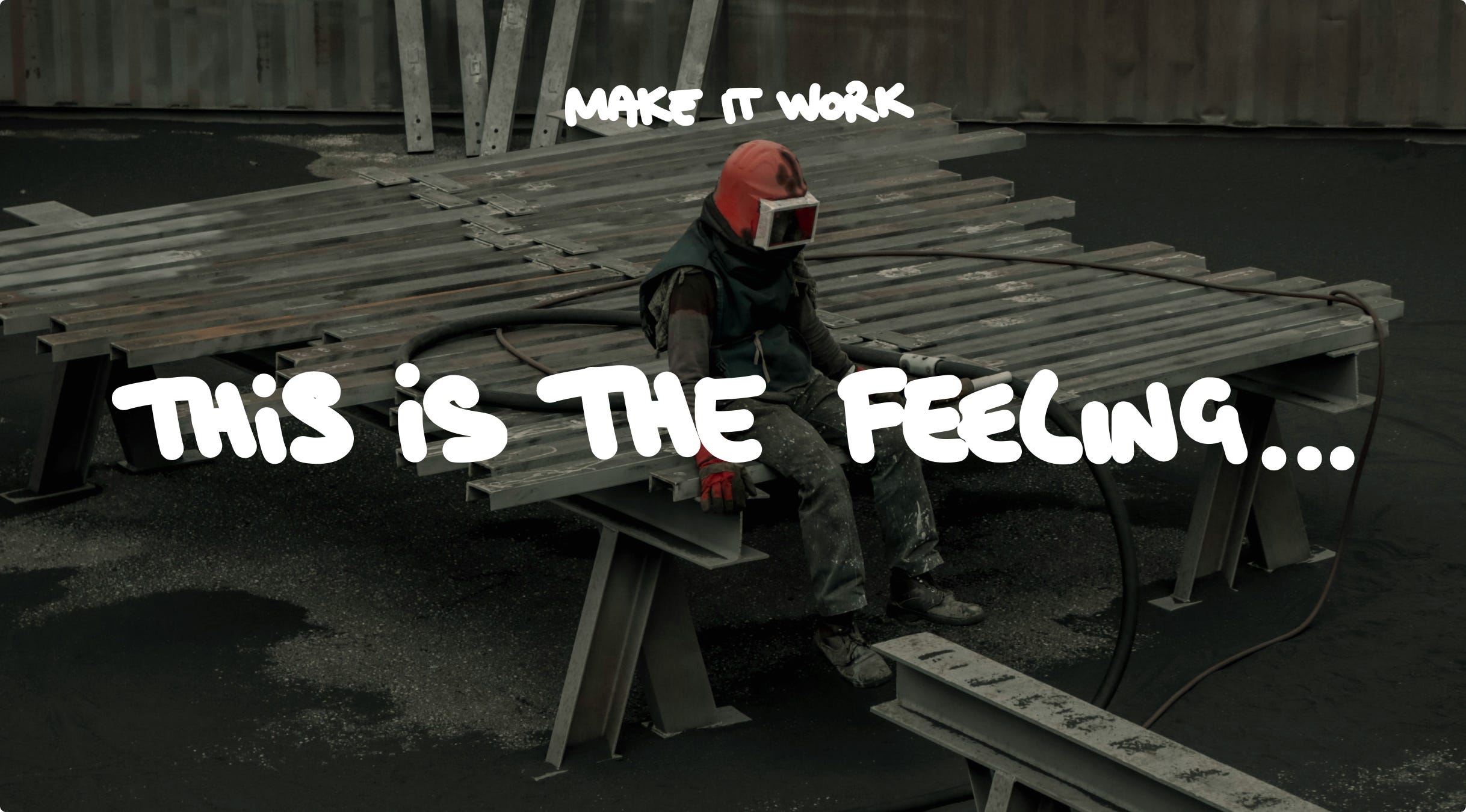
“Show me the meaning of being lonely. Is this the feeling I need to walk with?”
Backstreet Boys
Making things work? You might be very lonely
Leadership, solo entrepreneurship, solo building, and creative work are incredibly romanticized.
Look how inspiring Paulo looks, the artist spending many days alone in his studio. And Sophia, the programmer who doesn’t leave the house for weeks, hunched over in the glow of the screen, creating something important that will change the world. Jack, the leader of a small and ambitious team (of course united by one big goal!), working late, and then at night, at home, when his loved ones are already asleep (as always, they fell asleep before he came back), he still can’t sleep, thinking through the day that has passed and the day that is coming. And even Alex, working in a small NGO, tightly united like never before, keeps throwing himself into new challenges again and again.
These are the images we see in movies, books, and LinkedIn posts.
But very often, too often, behind all these images there is a long, dark shadow of loneliness. Personal and professional.
I think about this as someone who has worked in small teams for many years and regularly encounters this state, both in others and in myself.
This text is not a psychological study. It is rather an attempt to name and explore a phenomenon that we rarely discuss. And, of course, it is an invitation to a dialogue.
What kind of loneliness are we talking about?
When we talk about professional loneliness, we often mix several different experiences together. In reality, this loneliness appears in several different forms and contexts.
1. Lack of social and emotional connection
This is the loneliness of support. An emotional emptiness that often follows the person who carries things forward, when someone lacks recognition, attention, trust, and a simple human reaction to what is happening.
When there is no one to talk to about things that don’t work. When afterwork is a dull formality. When no one says “well done” when you actually did well. When no one asks, “What happened?” when something did happen.
We can organize as many team-building (I hate that word!) activities as we want, but real connections are built through trust. They are built through attention, not through bowling, excursions, or, heaven forbid, a personality-types workshop (I once attended one. It was terrible).
The loneliness of responsibility
This is the loneliness of the person responsible for decisions, responsible for trade-offs, consequences, and for reflecting on all of it.
The loneliness of someone who often has no one to discuss their choices with, no one to share their doubts with, or to safely express their fears (because leaders don’t get scared, leaders lead the way, right?).
The loneliness of being different
When you are simply different in the team. With a different experience. Different sensitivities. You react differently. You don’t fit into the rituals.
You might be an immigrant in a team of locals, the only female in a team, a humanities person in a team of engineers, or an IT professional working in a museum. You might be an introvert in a team of extroverts. I could keep listing examples forever.
2. Lack of professional companionship
This is my “favorite” kind of loneliness.
In recent years, I’ve been building infrastructure for research, communication, and media work at a nonprofit expert organization. And try to guess in one attempt: can I really discuss what I do with anyone?
I can discuss my colleagues’ needs and tasks with them. With contractors, I can discuss how we plan to implement certain solutions.
But most of the decisions I make myself. My colleagues are talented and real experts. But in different areas. What I do is mostly a black box for them. I connect their needs with the technical possibilities we can find in the outside world. And that is a very lonely path.
Here as well, we can identify at least a few different forms.
The loneliness of expertise
When you carry unique expertise in a team (for example, a tech specialist in a non-tech team), you are, by definition, alone. Who do you discuss possible solutions with? Who challenges your choice, who offers an alternative? Who teaches you, damn it? I’m not seventeen, of course, but just like everyone else, I want to learn and grow.
And this is a serious problem: without an external “mirror,” a person makes decisions alone, receives no feedback, begins to doubt themselves, or, conversely, loses their critical sense.
The loneliness of the generalist
Generalists are often lonely in any team and very often end up in professional isolation. Quite often, their functions and responsibilities revolve around them because of their generalist nature. The full cycle often sits on their shoulders, and you simply end up alone because… well, no one really needs to be involved, right?
You are responsible for several domains, your specialization doesn’t match the narrower specialization of your colleagues, and no one fully understands what exactly you do. The result? No professional dialogue, difficult feedback, no intellectual sparring.
You are part of the team. You are functionally integrated (because you are a node), but you are still alone.
This is a classic setup for generalists across industries, but it becomes even sharper in NGOs, cultural institutions, and small teams.
The loneliness of the solo builder
The most obvious form of professional loneliness. Entrepreneur? Freelancer? Independent author? You are incredibly free, but often incredibly lonely. This is the price of freedom: decisions made in a vacuum, without a mirror or sparring. Your decisions and trade-offs are only yours. No one says, “Dude, this is nonsense!” No one says, “Dude, this is fire, don’t stop!” No one says, “Damn, let’s do this together!”
3. Loneliness created by organizational culture
Sometimes loneliness is created by the organizational culture itself when it is not acceptable to talk about doubts, mistakes are seen as weakness, discussion of problems is replaced by demonstrations of confidence, and admitting fatigue or overload is considered unprofessional.
In such an environment, people begin to hide the real difficulties of their work, conversations become superficial, and professional doubts remain unspoken.
When an organization's culture does not allow for vulnerability or honest discussion of difficulties, professional loneliness becomes the norm.
People continue to work together, but they stop thinking together.
Workplace loneliness and social isolation
In the work The Emotional Labour of Boundary Spanning, the authors (Catherine Needham, Sharon Mastracci, and Catherine Mangan) emphasize that workplace loneliness is not the same as social isolation.
You can work in a large team, even in an open space, and still experience professional loneliness. Because it is driven, first of all, by the absence of meaningful professional connections: no one truly understands you, you have no one to discuss complex challenges and tasks with, and there is no sense of professional belonging or alignment.
Loneliness as a symptom of burnout. And a growing trend
This sad journey is easy to see: you feel loneliness, engagement decreases, emotional exhaustion appears (without emotional, social, and professional support) and… burnout.
Moreover, we can see that the problem is becoming more and more relevant due to several factors:
the rise of remote work
high specialization
the growth of project-based work (and project work, by its nature, does not support long-term engagement)
On top of that, the trend toward small teams also contributes to the problem.
There is a paradox of small teams: often, they are socially very close and connected, but professionally very fragmented. One person handles marketing, one handles product, one handles partnerships, one handles operations… alone, without a “professional peer”.
Generalists are in danger!
A generalist is almost an incubator of loneliness. First, their role is poorly understood. Second, they (we!) almost have no professional community.
A specialist can say: I am a product manager, I am a UX designer, I am a data scientist — and find conferences, books, LinkedIn groups, communities, mentors.
A generalist describes themselves and… very often it is a unique description that doesn’t place you in any community. Hell, at nine out of ten professional conferences, I feel like an impostor.
So, what next?
For small teams, generalists, and solo builders in almost any industry, there is almost no professional support. There are almost no simple, safe, and accessible spaces where people with a similar reality can talk honestly with each other.
The classic solutions (training programs, courses, development programs) do not solve this problem. They provide knowledge, tools, and sometimes even inspiration. But they almost never provide intellectual and human support, and the possibility of a meaningful exchange of experience with the context in mind.
I feel that support in this environment should be built around several interconnected dimensions.
Recognition
First, a person needs to see and name their situation. This is quite a challenge. To understand that what they are experiencing is not personal incompetence and not an individual weakness, but the structural reality of small teams and working solo: mixed roles, blurred responsibility, the absence of a mirror, lack of support, constant pressure to do everything at once, and the absence of slack.
Recognition is the moment when you realize: “I’m not broken. I see the problem, it is structural, and I’m not alone with it.”
Understanding
The next step is to understand what exactly is happening. Why does professional loneliness appear?
Why generalists often burn out. Why is it so difficult in small teams to receive feedback, to grow, and to see your trajectory?
Understanding is an attempt to build a map of what is going on, to see the mechanisms that usually remain invisible.
Craft
But understanding alone is not enough. At some point, the question appears: what can be done in practice?
How to organize work with limited resources. How to protect your role. How to talk with managers or with the team. How to build a career if you are a generalist. How to look for support and how to give it.
Craft is shared practice: advice, frameworks, working methods, and approaches that help you move forward.
Infrastructure and Space
And finally, all of this is almost impossible without infrastructure.
By infrastructure I mean not only technology, but also tools, formats, and spaces that make conversation, exchange of experience, and collective thinking possible.
These can be small products, tools, or communities — anything that helps people not remain alone with their reality.
Final advice
In a way, this essay is my attempt at recognition. And for now, I only have two simple takeaways:
Share your experience of professional loneliness and your experience of dealing with it. You can start with a comment under this article. Or send me a private message or an email. Sharing is caring.
Listen to Backstreet Boys!

Related articles ↓


Oh I relate to a lot of this. And I agree that the generalists are in danger, yet they are so, so needed.
Reminds me a bit of my own situation. Which has a bit of a different pain point. My peers are senior leaders of other functions: sales, customer success, marketing, etc.
People whom I work with every day are my subordinates. We can work, joke, and go for lunch together. But if need be, I will let them go, because it is my role, and it is part of what managers do.
It sucks.