

The Overperformer’s Challenge in a Small Team. Managing the experience
A paired reflection on overperformance and sustainability in small teams


This piece is part of a paired set of essays. Two authors reflecting on the same problem: burnout, overload, and motivation loss of overperformers in small teams — from two different perspectives.
What you’re reading now focuses on possible ways forward.
The second part, written by Diana, explores the lived experience of an overperformer from the inside. I encourage you to read the second part!.
You can read Diana’s piece here →

Damn, rain all day. Of course, this shitty weather is a perfect addition to today’s meeting. A 1:1 with Diana. I’m still not fully oriented in this small team, but it really looks like Diana is the one carrying most of it.
I want to understand what’s going on because it feels like she’s constantly dissatisfied with something ˙◠˙
There are only four of us, and we can’t afford to have one unhappy colleague.
And the rain… well. You don’t choose the day for hard conversations.
“Hi Diana! Ready?”
“Hi Danil, yes, ready 😊”
….
Everything Diana shared with me turned out to be a double-edged blade — hurting her and posing real risks to everything we’re trying to build.
Traps, loops, and struggles
The conversation with Diana turned out to be difficult, and it surfaced several issues.
1. The knowledge trap
Diana has become a single point of failure, but this problem is broader than just one person. It means there is a serious imbalance of responsibility and ownership within the team. When one person becomes “responsible for everything,” the rest of us get used to the cozy idea that ownership and accountability live somewhere else, not with them.
2. Responsibility keeps growing
Tasks, expectations, responsibilities grow without any agreements or trade-offs. We’ve lost intentional role design, and over time, this turns competence into a burden.
3. Loss of boundaries
Something is broken in the team’s culture of mutual support. Help is not the same as exploitation! In the long run (and not even a very long one!), these tendencies lead to two outcomes at once: learned helplessness in the team and burnout for Diana.
4. The urgency treadmill
“Everything is urgent. Everything is a priority.” There are two hidden problems here.
On one level, it’s clear that the team lacks a shared vision.
On another hand, Diana, having acted as a constant support structure for so long, has lost the ability to set priorities herself (out of fear of letting others down).
5. Motivation erosion
This one is obvious (and sad), but it goes deeper than individual exhaustion.
When systems and processes are designed in ways that strip people of agency and ownership, motivation erodes across the entire team.
The conversation was long. The rain had already stopped. It was dark.
We were sitting there, exhausted, leaning back in our chairs, staring at the whiteboard — where, piece by piece, we had mapped out our plan for change.
Here is our plan
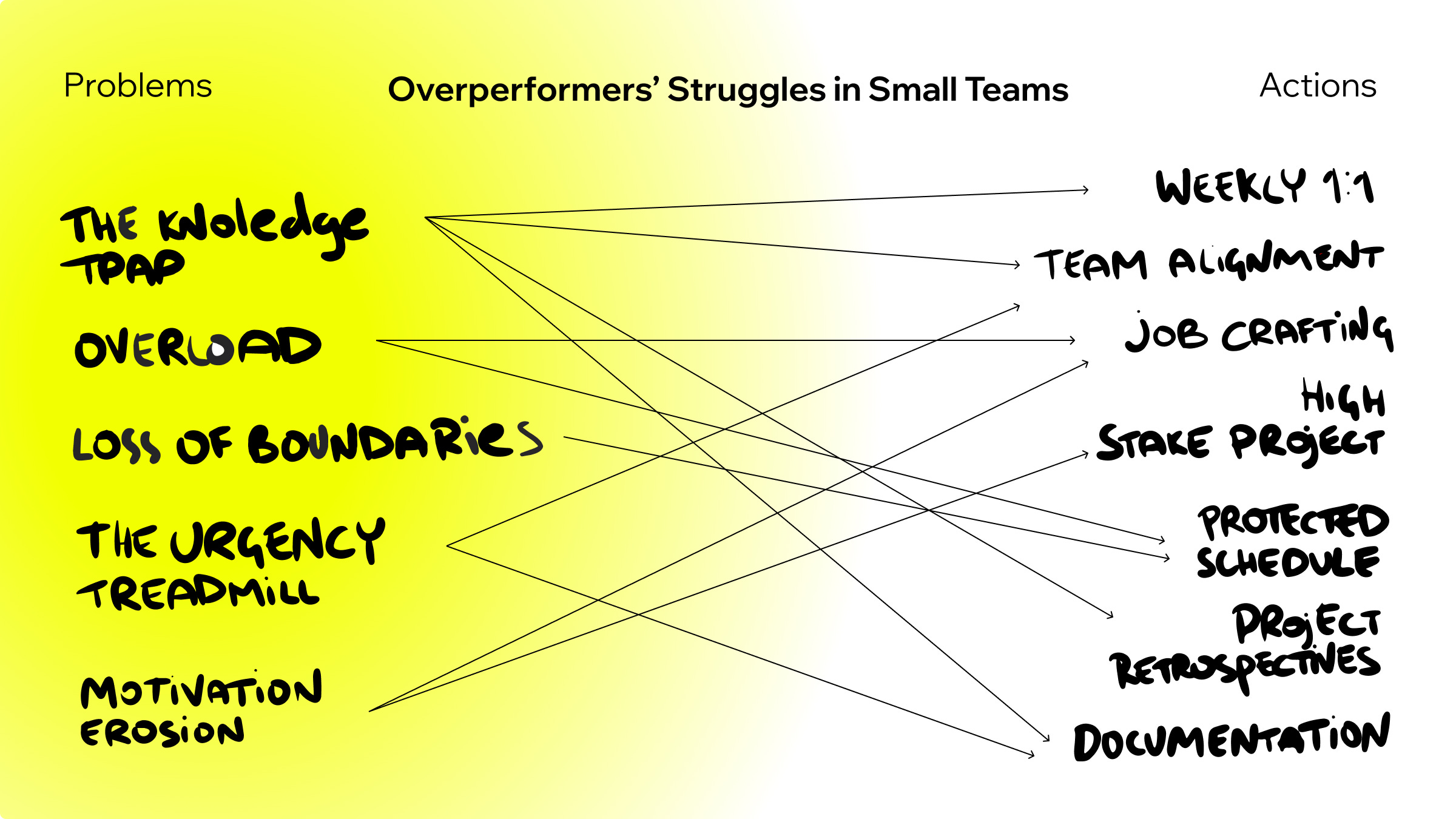
1. Weekly 1:1s with everyone.
Every week without exception.
The goals are simple:
to hear the whole team
to return a sense of agency
to keep a close pulse on how people are doing
We want everyone to clearly understand their contribution and what’s expected of them, and to feel seen. For too long, too many things just worked by default.
2. Alignment as a fixed part of team meetings. Not just status updates
what we’re doing and why
what matters right now and what doesn’t
where responsibility and ownership actually sit
3. Job crafting.
To restore Diana’s sense of agency, we agreed to give her more control over how her role is shaped.
Diana takes a week to reflect and comes back with an answer to one key question:
“Which parts of your work give you energy and which ones drain it?” Then we sit down and discuss how to adjust her job landscape to reflect that answer.
Research shows that people who regularly use their strengths burn out less, even under a high workload. We decided to take that seriously.
4. High-stakes project!
For people like Diana, the strongest motivator is working on projects that actually matter for the whole company.
We have a major client project ahead. The biggest in our history. If it succeeds, it will fundamentally change the company’s future. Diana will lead it.
My role is to provide the why and the what. Diana will definitely define the how.
5. Protecting focus without breaking the team.
To reduce the incoming chaos around Diana (without throwing the rest of the team into a state of helplessness), we reworked how her time is planned.
Now there is a fixed three-hour window once a week during which Diana responds to colleagues’ requests unrelated to her project. Only those three hours.
This forces the team to prioritize their questions and solve what they can on their own
6. Shared project retrospectives.
After every project (even the smallest one!) we now hold a retrospective wth the whole team.
That’s where we talk about:
what worked
what didn’t
why
and how to do it better next time
This helps Diana stop feeling solely responsible and helps the team regain a sense of ownership.
7. We treat documentation as delivery
Yes, Diana, this is additional work. And we’re being explicit about it. You have two weeks before the new project starts. Document.
We identified the most frequent questions and processes for which Diana’s help is consistently needed. We will create guides and onboarding materials for the most critical and painful areas.
Diana will also document key decisions in detail, so they become part of project retrospectives and feed into our shared knowledge base.
In the long run, this will reduce Diana’s load and allow the team to learn and grow independently.
8. And yes, we talked about financial motivation too
But that part stays under NDA 🙂
We looked at the whiteboard. The whiteboard looked back at us.
It was time to act. But not today. It’s already 19-00.
“Diana, thank you for the conversation and for your trust. Tomorrow we’ll start acting. For now, have a good evening! Please rest and don’t think about anything tonight.
See you next Tuesday!”
Thanks for reading!
A quick housekeeping note before you move on.
My name is Danil, and this is Make it Work — a shared space for knowledge and support for generalists working in small teams and initiatives.
I write about how projects, ideas, and people survive and grow when resources are limited and roles are blurry.
No growth hacks. No bad-taste coaching. I promise.
See you next week!
Best,
Danil | Make It Work
 | A guest post by
|