


I write about turning knowledge and expertise into impact — the formats, channels, and infrastructure that help it reach people and work. I write for people working on knowledge-driven initiatives: research organizations, NGOs, cultural institutions, academia, media projects, public interest platforms — specialists and generalists building things that matter, often within imperfect structures with limited resources.
Let’s talk about the overproduction of knowledge and expertise in the age of AI, and try to figure out what to do with all of it. We’ll try to find and discuss something interesting, walking the thin line between “AI will kill real intellectual work” and “AI is just a tool”, and “It’ll save us all.”
This piece was inspired by a great article, The Work of Knowledge in the Age of AI Reproduction, by Rex Woodbury. It’s worth reading yourself, so I’ll try to keep spoilers to a minimum.
We’ll just push off from one of the author’s ideas (like off the wall of a pool, and swim from there on our own).
The author (forgive me for the loose retelling) points out that AI does to knowledge what the film industry and copying technologies did to art — it reproduces the artifact, lowering the value (and the price) of each individual copy. Something like: there’s one Mona Lisa, and that’s what makes it valuable; prints of the Mona Lisa are copies, stripped of aura, available to anyone.
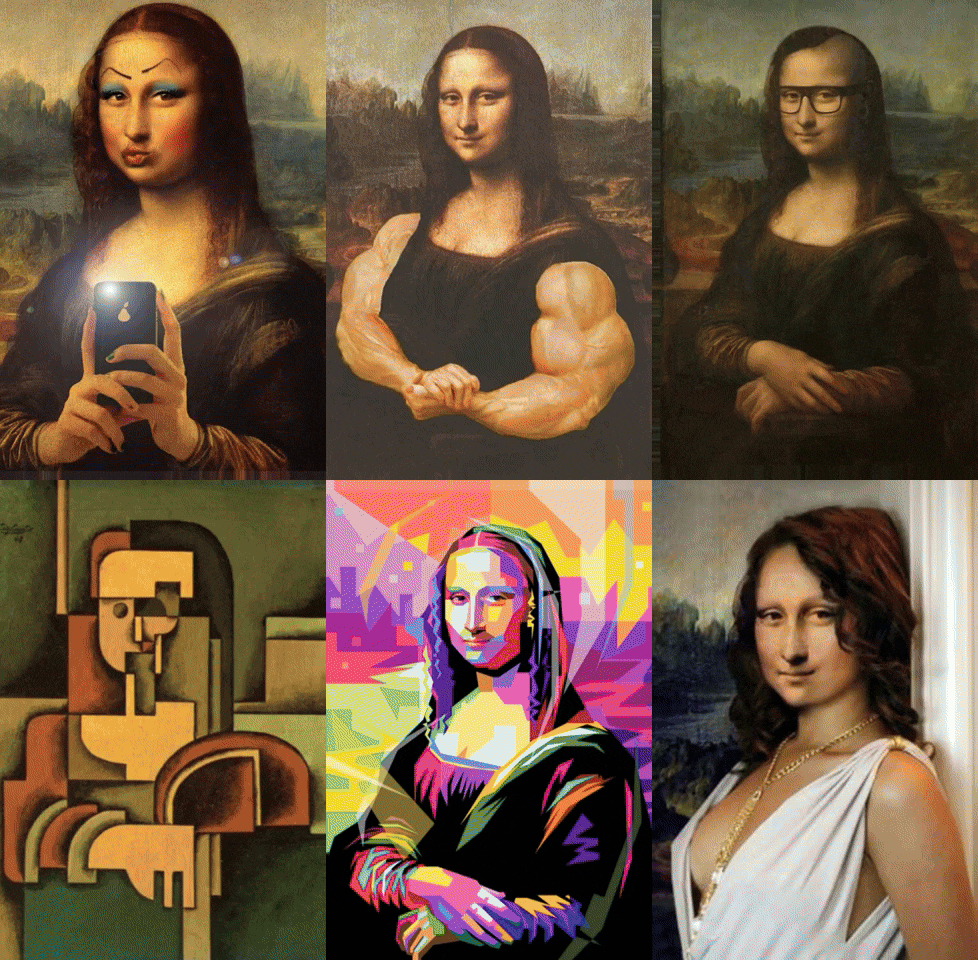
We face the same risk with knowledge: when content is copied and overproduced through AI, the price (and very, very often the value) of knowledge and expertise drops. Because knowledge gets reproduced, but judgment, decision, and the responsibility behind it don’t.
AI doesn’t reproduce judgment and the responsibility behind it — who signs their name to it? Who’s on the hook (even just reputationally) if it’s wrong?
In art, the answer to the question of responsibility, judgment, and choice was the birth of the institution of curatorship (individual, like Harald Szeemann, or organizational, like MoMA, Saatchi Gallery).
Someone had to take on the responsibility of choosing and stating: this is art worth your attention. We delegate the right to judge — we trust this curator, this museum, this gallery, this biennial to act as intermediaries and choose what’s worthwhile, important, “the best” art.
I hope the same process is starting to happen with knowledge.
In my own work, I see the amount of sociological data, opinions, and expertise growing fast.
At the same time, we’re seeing a growing trust gap between plain data or opinion, and data and opinion coming from institutions and organizations with an established track record.
The risk of running into AI slop, into fakes, is growing so fast that someone needs to stand next to the data and say: yes, I take on the risks tied to the quality of this knowledge, this data, this expertise.
I see a big future for the curatorship of knowledge.
This doesn’t work through a one-time claim of “trust us,” but through the accumulation of authority. A curator lowers your risk not because they’re smarter than you, but because they’ve already put their reputation on the line many times before, and you can check that.
MoMA is valuable not because geniuses work there, but because decades of selection, decades of discussion, criticism, and probably mistakes have built up expertise, standards, and reviews. All of that is there for you to check.
The same thing happens with institutions of knowledge and expertise: every time an organization publishes data, discusses it openly within the professional community and the general public, sells a report, shows its own financial numbers, it either strengthens that credit of trust, or spends it.
That’s why trust in knowledge can’t be bought with a one-time claim of expertise — it’s built as slowly as a museum’s or gallery’s collection and portfolio: exhibition by exhibition, conference by conference, publication by publication.
This also brings us to another idea: that branding of knowledge, communication around knowledge and around the institution (or individual) behind it, is a critical task.
Building trust, building authority, building the image of a knowledge curator is no less important than the timely and effective production and delivery of expertise itself.
For example, the numbers from the consulting industry show that changes tied to the rise of AI are of course happening (for example, the old model of hourly billing is under pressure), but the overall consulting market isn’t shrinking.
And the leaders’ revenues (from Deloitte and Accenture to PwC and EY) keep growing.
One reason is that the cost of a brand, and of trust, keeps going up, while the cost of producing knowledge and expertise, if anything, keeps going down.
And that makes sense. You can ask AI a question and trust its answer. That’s cheap, and it’s fast.
You can go to an expert (who also uses AI, and that’s fine) and get an answer. That’s more expensive, and slower.
But in the first case, you take on all the risk yourself. In the second, you delegate part of the responsibility to someone you — and the market — trust.

And just as art curators lowered the risk that you’d waste time and money on bad art (and, god forbid, you actually liked it and were careless enough to admit it in front of your high-brow crowd of friends), “curators of knowledge” lower the risk of trusting low-quality data or conclusions.

Thanks for reading!
See you next week!
Best,
Danil | Make It Work