

Job Design in Small Teams: Trying on a Harvard Framework
What happens when a corporate framework meets a team without slack

This text is an experiment. It's my first try to understand what happens when management frameworks built for large organizations are applied to small teams (teams with no spare resources, no buffer roles, and very little room for error).

Today, I’m looking at one of the strongest job design models developed at Harvard Business School by Robert Simons and asking a simple question:

Where does this model work and where does it fall short in small teams and early-stage organizations, and how can it be adapted?
Fair warning: this is a damn long article. Part of me wants to apologize for that, but then again, we can’t just live on coaching reels!What is the Job Design Model by Robert Simons
As I was taught in a university course on formal logic, before reasoning about something complex, it helps to first agree on the terms. Let’s try to do that briefly and, as much as possible, without drifting into corporate heresy.
So, job design by Robert Simons (Harvard Business School) is generally obvious: it is the process of structuring job components to enhance employee satisfaction and organizational effectiveness.
Four spans of job design
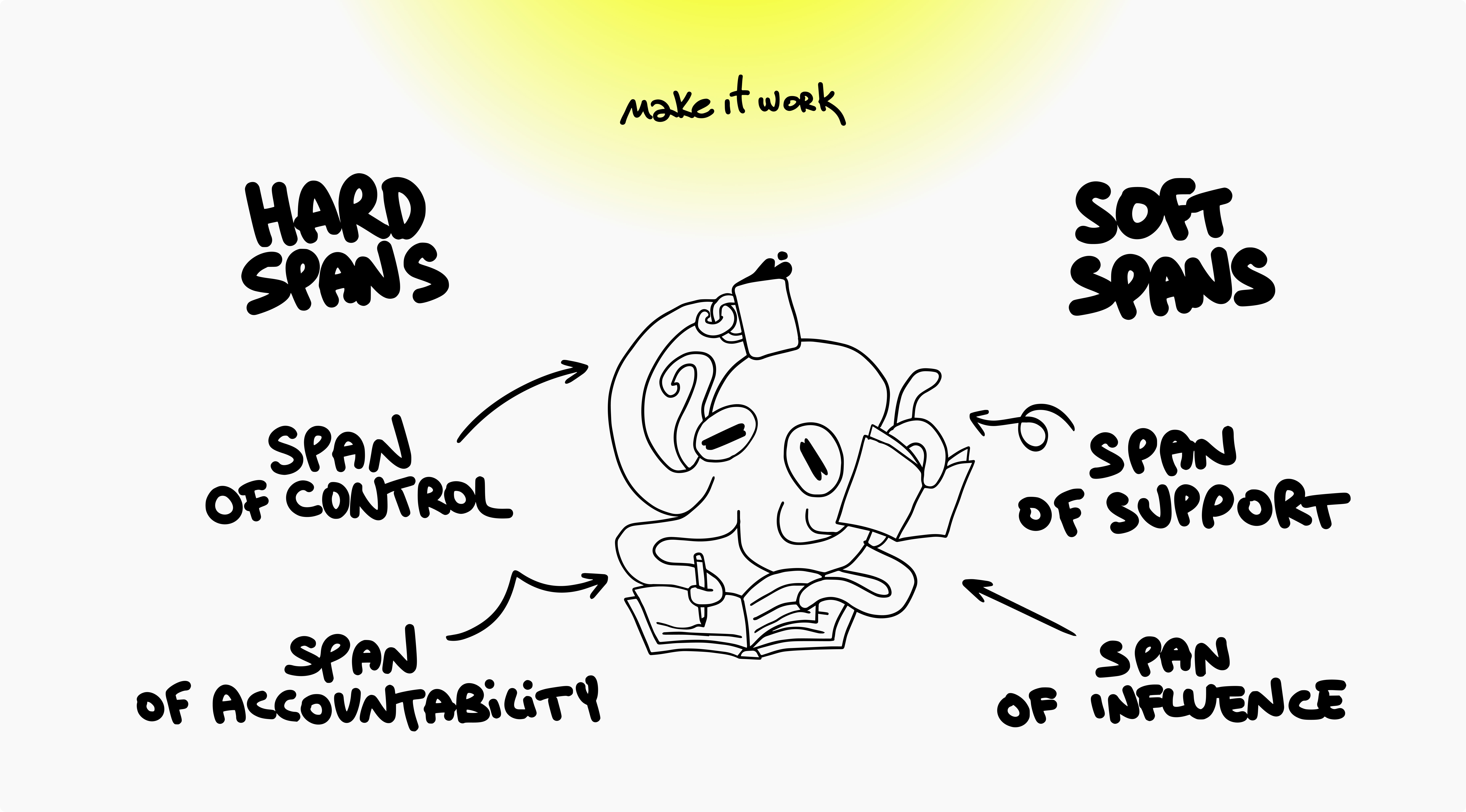
“Hard” spans:
Two “hard” spans (span of control and span of accountability), focus on the traditional dimensions of job design, determined and described in job descriptions, organization charts, and performance measurement systems.
Span of Control — what you “control.” This is what you can manage directly, without someone else’s “yes.”
Span of Accountability — the level of complexity of the outcome you are responsible for. Is it a simple and unambiguous result, or a multidimensional one with conflicting goals and trade-offs?
“Soft” spans
Two “soft” spans (span of influence and span of support) is about more abstract and less measurable aspects: levels of interaction and helpfulness among employees.
Span of Support — the kind of support you can realistically rely on when things get stuck.
Span of Influence — the ability to achieve results through other people and systems that do not report to you.

A baseline example of job design in a large organization
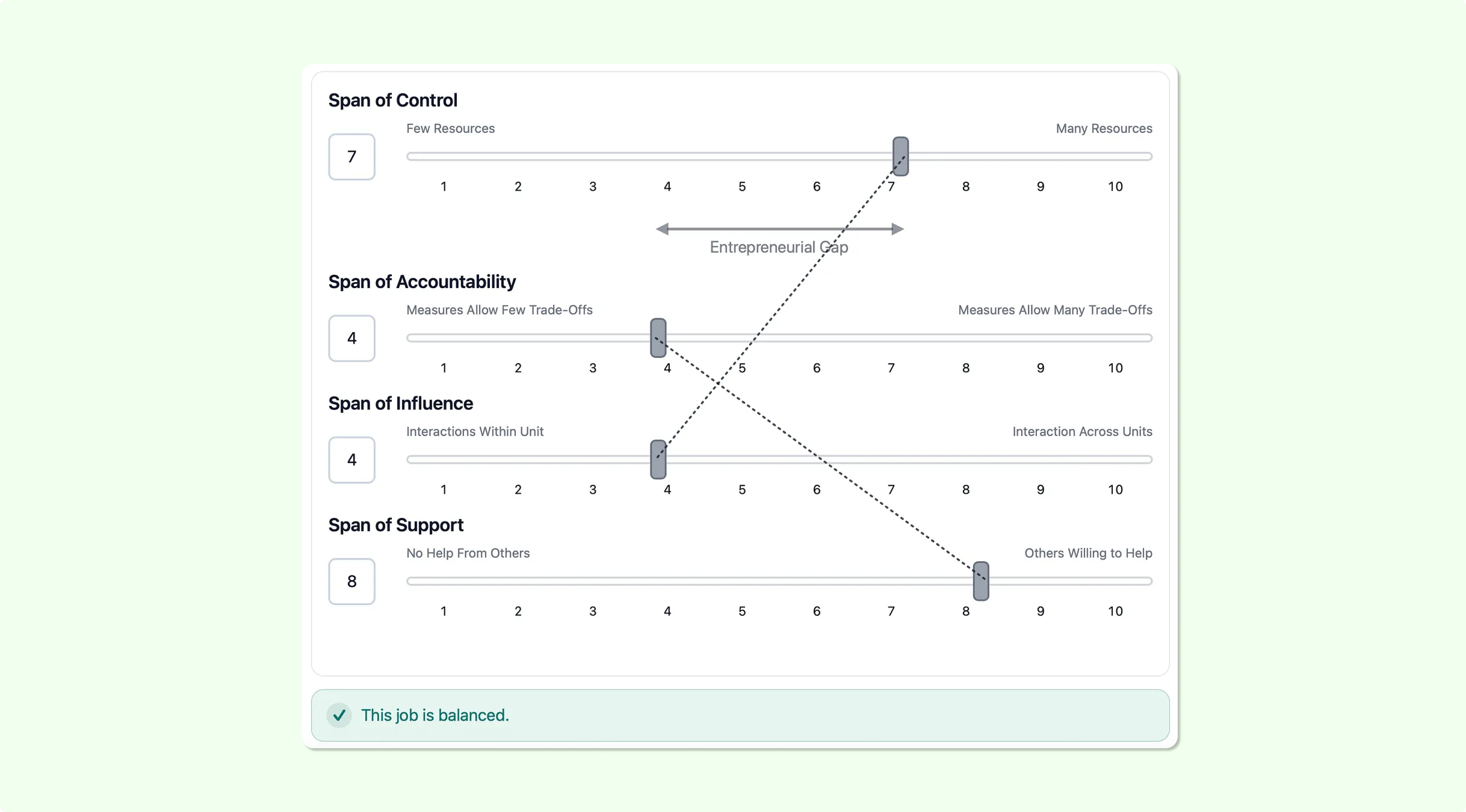
I, forgive me for this, created a small widget to illustrate the model as Robert Simons describes it. You can also play with it via the link.
If something breaks, I’ll share the GitHub access so you can fix it, because at that point I definitely won’t be able to 🙂Entrepreneurial gap and the balance
We won’t dive into every detail of the framework (those who want the full picture can always pay for the HBS online course), but we will focus on two things that matter for the rest of this discussion:
1. The entrepreneurial gap
It is the result of a designed mismatch: the span of accountability is wide, while the span of control is narrow. This gap is intentionally created to force employees to innovate and to influence those who control the resources they need in order to get results.
2. Balanced job design
Balanced design (in my simplified reading of Simons) means structural coherence across all four dimensions of a role.
In other words, the demands of the role and the capabilities of the role exist in the same logical space.
Traditionally, leaders tried to design roles so that responsibility (span of accountability) matched authority (span of control), because for a job to succeed, supply must equal demand.
My widget (based on the logic of Job Design Optimization Tool JDOT developed at HBS) lets you explore this balance by running the so-called X-test: the line connecting accountability and support should intersect with the line connecting control and influence (are you still here?).
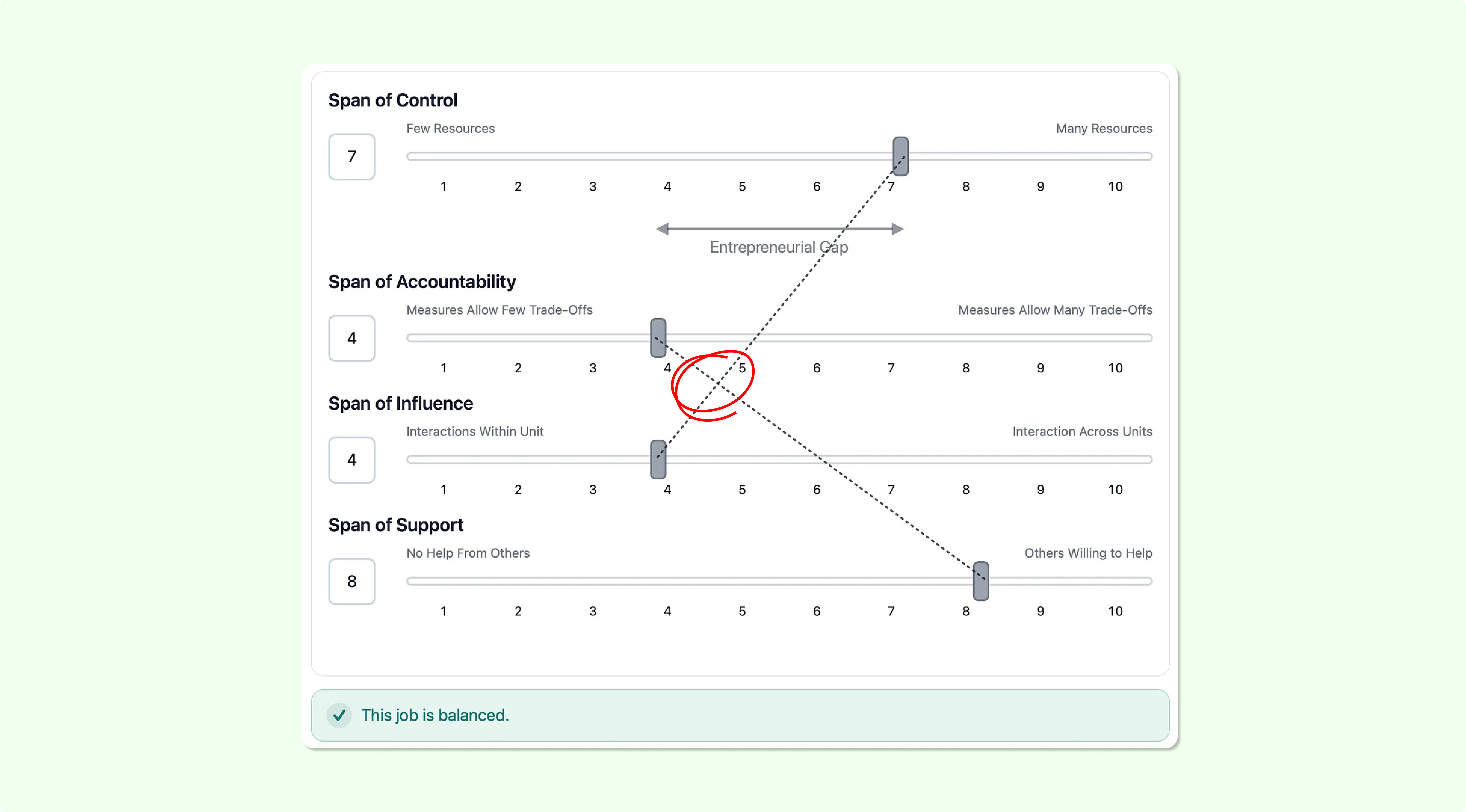
If we want innovation and dynamism, we also need an entrepreneurial gap, as shown in the widget.
So far, so good.
Now let’s put the book aside, shake off the corporate haze, look around at the eight people on your team, and try to understand how all of this actually works where we are.
If this sparks your interest, you can read more on the Harvard Business School Online website. Okay, but how does this work when there are eight of you?
The model is the same, but it behaves very differently in large organizations and in small teams. Why?
1. The room to adjust any span is different and much smaller
✦︎ Span of Control
In large organizations, this span ranges from 1 (almost no control) to 10 (maximum control). It is based on the slack that large organizations have. Control adjustment is not unlimited, of course, but it is structurally available by design.
In small teams, the span of control is structurally narrow and less adjustable, and this is dictated by the very nature of small teams: resources are scarce, most roles do not own a budget, people can’t hire or pause work independently, scope can’t be changed without negotiation, and decision rights are shared rather than held individually
In large organizations, the span of control can range from 1 to 10, while in small teams it typically ranges from 1 to 5.
✦︎ Span of Accountability
In large organizations, a person’s span of accountability can be wide or narrow depending on their function, position, and place in the hierarchy.
For example, an executive’s performance may hinge on the organization’s market value or long-term growth, while a social media specialist is often accountable for much narrower measures, such as the number of posts, engagement rate, or reach.
When a role is expected to be creative and innovative, it must involve frequent trade-offs. This means holding people accountable for broader outcomes, not just narrowly defined outputs.
In small teams, things work very differently.
People often perform multiple roles at once, and each role can imply a different span of accountability (designer in the morning, strategist by the evening).
Small teams are almost destined to have wide spans of accountability, because responsibility is rarely tied to a single function. More often, it is tied to a piece of reality. In a small team, it is nearly impossible to break responsibility down in a way that meaningfully narrows the span of accountability.
In small teams, the span of accountability realistically ranges from 5 to 10 (don’t forget, this is not a precise measurement, of course. Think of it as a relative scale and a diagnostic exercise, not a ruler).
✦ Span of Influence
In large organizations, this span can range from 1 (which is rare, but the night guard at your warehouse might genuinely sit at a strict one) to 10.
In small teams, however, the span of influence is almost always wide by default because specialization is limited, resources are shared, and almost any meaningful work cuts across multiple roles.
Here, influence is not an optional skill you occasionally use; it is the primary way work gets done.
For the purposes of this discussion, we can assume that in small teams, the span of influence should range from 5 to 10.
✦ Span of Support
According to Simons, organizations with wide spans of support share four key attributes:
Pride and purpose: Employees who are inspired by the organization’s mission are more likely to help others achieve shared goals.
Group identity: Selective hiring makes people feel part of a distinct group, fostering camaraderie and a willingness to support one another.
Trust: People must feel safe being vulnerable and asking for help.
Fairness and equity: Employees are more willing to support others when recognition and rewards are perceived as fair.
In large (and healthy) organizations, the span of support is institutionalized and distributed across managers, formal processes, HR, coaching, and other systems. Support is relatively predictable and does not depend on a single person.
In small teams, however, the span of support is usually personal rather than institutional. There is no HR buffer, no spare manager, and no system to absorb overload. Support depends on direct access to the founder or team lead, informal norms of helping, psychological safety in admitting uncertainty, and a shared willingness to pause and rethink priorities together.
In small teams, the span of support compensates for almost everything the team can’t provide structurally and therefore should realistically range from 5 to 10.
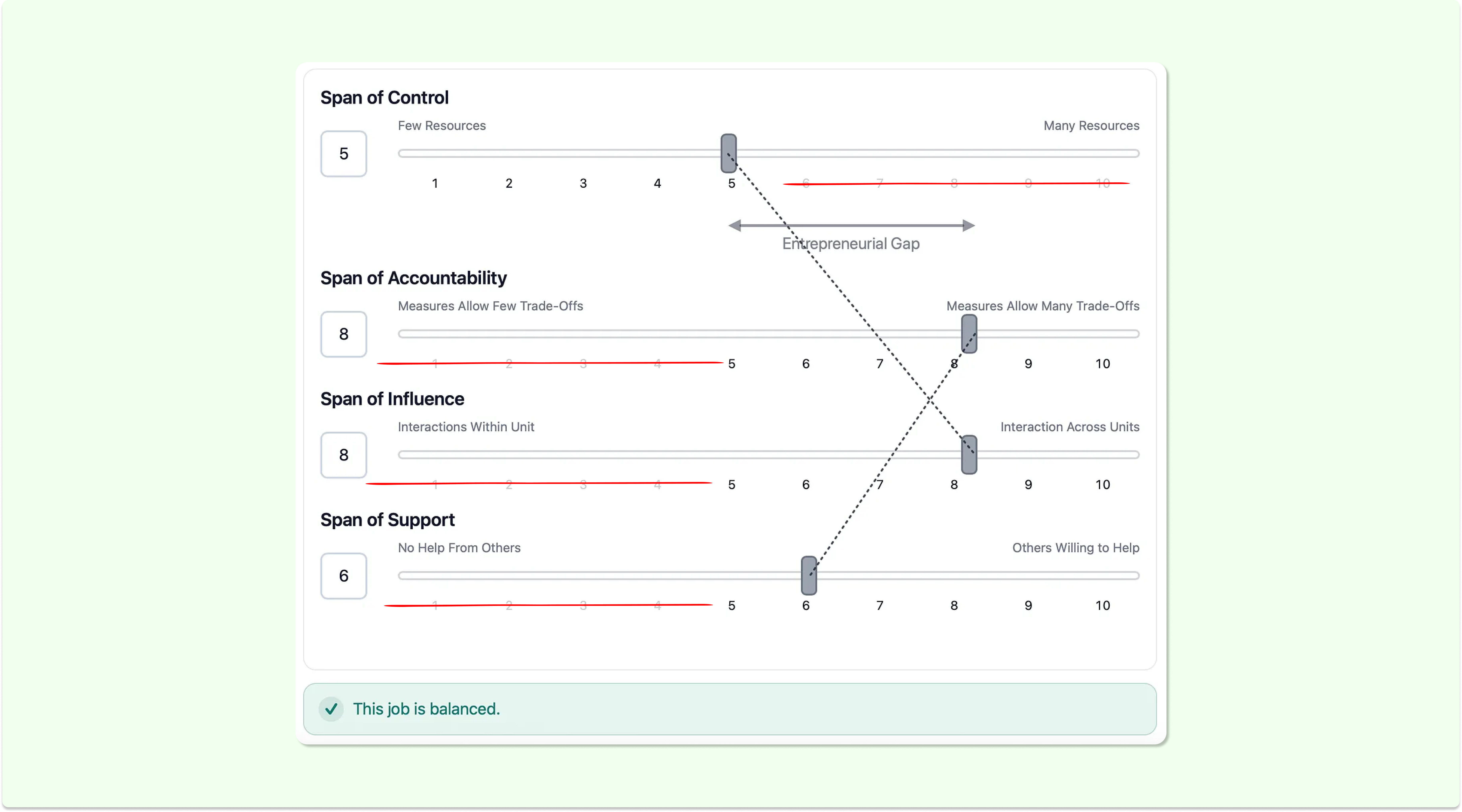
I also made (someone please stop me!) a widget for modeling job design in small teams — you can try it out via the link.2. The room to adjust any span is different and much smaller
From everything said above (yes, this text did get long): in large organizations, the entrepreneurial gap is usually an intentional choice. Two key spans (accountability and control) are deliberately misaligned to create it, while the other two (support and influence) are adjusted, where possible, to compensate. It is a design decision.
But what about small teams?
The entrepreneurial gap in small teams is not a feature. It’s a built-in constraint.
In small teams, control is structurally narrow by default, while accountability is almost always wide. This makes the entrepreneurial gap far less adjustable and often much larger than intended.
In small teams, people are not “encouraged to think like entrepreneurs”. They are forced to, because there is no alternative.
Conclusions and lessons (finally!)

1. Control can’t be expanded. Support!
In a small team, you almost always can’t suddenly add budget, hire people, delegate “downwards,” or create buffers and slack.
You can’t just jump over the entrepreneurial gap. Here, we need wings, and those wings can only be Support.
2. Accountability can’t be removed, but it can be clarified
In small teams, accountability is almost always wide: Patrick is responsible for marketing (whatever that means), Laura for the product (good luck, Laura!), Maxim sits on sales (Patrick, move over, it’s the same bench!), and so on.
When accountability is wide, metrics must be honest, not “ambitious,” taking constraints and dependencies into account.
A bad example (Patrick, why are you on the windowsill?!):
“You’re responsible for growth, but the budget is zero, the product can’t be touched, and the team is busy.”
A fair example (get down, Patrick!):
“Your area is hypotheses, experiments, and signals. Growth is a collective responsibility.”
Accountability remains, but it no longer becomes a moral trap.
3. The entrepreneurial gap can’t and shouldn’t be closed. But it can be made passable.
In a small team, almost always, accountability > control. And our task is to help the team get across this gap without losses. This is where Influence and Support must take center stage.
Influence must be fast and legitimate. If moving a task forward requires three meetings, personal charisma, or catching someone at the right moment, influence is effectively blocked, and the entrepreneurial gap becomes toxic.
Support must be practical and accessible. It is not a value or a declaration. It is the ability to actually get help at the right moment.
4. Leadership is role design, not slogans
“Be proactive.” “Take ownership.” “Think like an entrepreneur.”
In large teams, this might sometimes work in one way or another (though plenty of things don’t work there either). But in small teams, this approach is a symptom of unresolved design gaps.
And those gaps need to be addressed structurally. You can start by playing with my widgets 😄
Widget for small teams
If you’ve read this to the end, thank you!
If you disagree, feel something important is missing, or have anything on your mind, I’d love to hear it in the comments.
I like this. Thank you. Resonates with some of my work but from a different angle. Interesting. It's getting me thinking!
Thank you I didn’t know about the model. If I got it right it boils down to small team’s members have a lot of things to do but no resources or structured support.
In larger organizations it can be simulated by putting constraints on the team. People might get creative. I am doubtful about just telling them to become mini-entrepreneurs if organizational culture does not support it.