

Hunting the Elephant: Find It. Name It. End It
How to recognize, name, and stop recurring underperformance before it erodes accountability, trust, and culture.

This article is dedicated to a difficult, painful, and unfortunately very common problem — not noticing the elephant in the room. When culture, politeness, values, traditions, and habits prevent us from calling a problem by its real name — whether it’s a person or a situation.

Let’s unpack how to recognize the elephant in the room, and what to actually do about it.
The water in the glass on the meeting room table trembled, spreading in concentric circles. Then again. And again. It was the heavy tread of an elephant entering the room. An elephant that no one notices. An elephant that cannot be named. Elephant-Voldemort.
The windows fog up from his breath — we tend to think the whole team should just breathe a little less.
All the dishes in our kitchen are shattered — next time we’ll buy unbreakable ones.
We’ll make the corridors wider! The chairs — deeper! We’ll even add a hairdryer for the trunk in the bathroom!
In our inclusive team, this is how we always act. After all, we are all different.
But there’s “different”… and then there’s DIFFERENT.
Definition of the Elephant
Our elephant today is a person. It is something that prevents the whole team from working, erodes the culture, and constantly messes things up. Our elephant is also the reaction of the team, the organization, the management, when no one does anything about it, when no one calls it by its name (as if the moment you pronounce it, a gust of wind will blow out the candles, thunder will crash, and everyone will shiver from a draft that seems to come from nowhere).
Our elephant is the problem of hypertrophied loyalty, a twisted inclusion dial, poorly formulated and poorly understood norms and values.
It is the reaction of management. It is an organizational choice to do nothing.
And beyond broken dishes and awkward moments at retrospectives, an unnoticed elephant leads to far more serious consequences:
unfair redistribution of workload
burnout of the strongest
loss of the best employees
normalization of mediocrity
erosion of trust in leadership
imitation of productivity
failure to achieve OKRs and KPIs
and the gradual erosion of culture
Where the legs grow
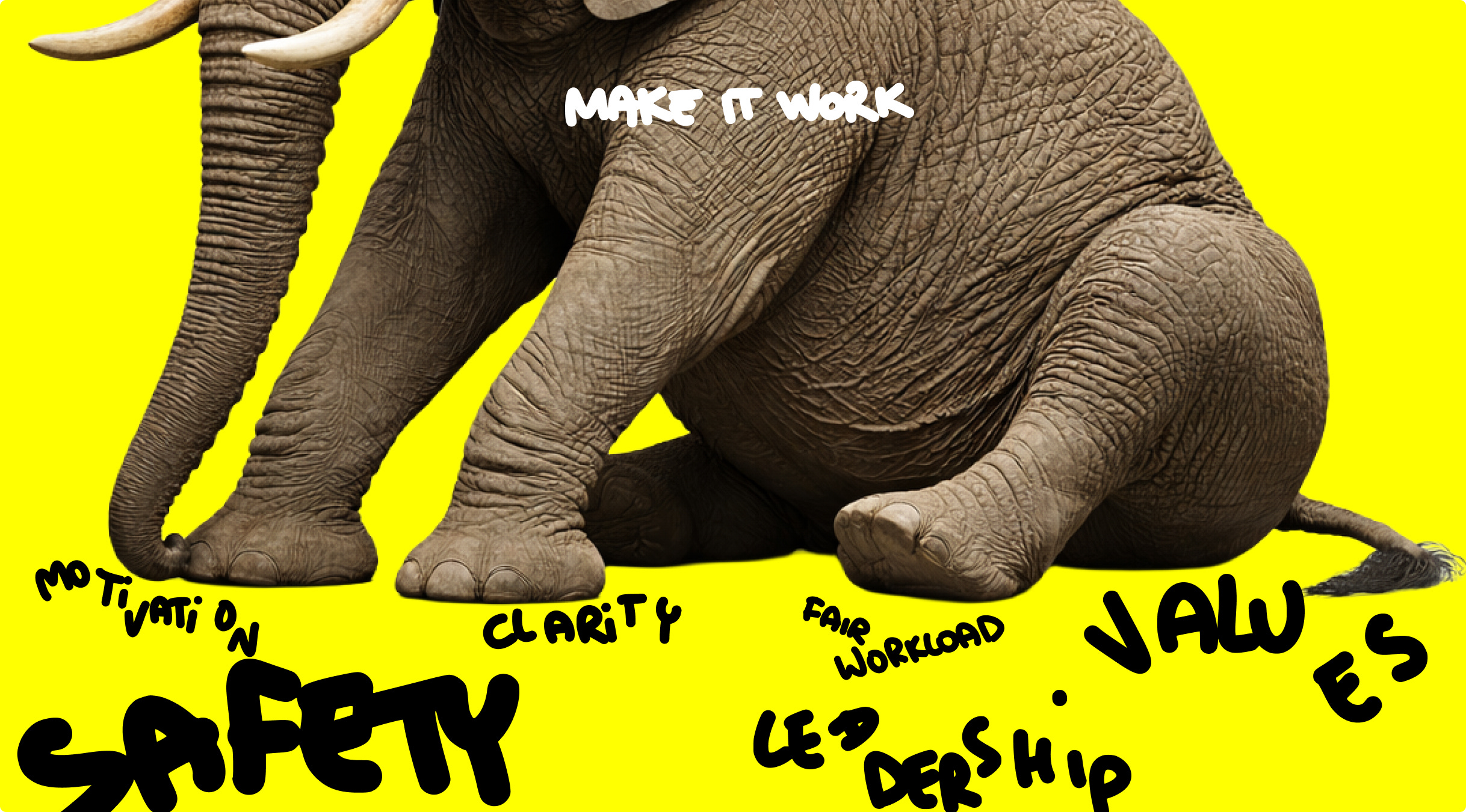
The elephant is here, but after all, we are all devoted followers of Blameless Postmortem with its:
Focus on the system, not the individual: Instead of asking “Who did this?”, the team asks, “Why did the system allow this to happen?”
Psychological safety: Participants are not afraid to admit mistakes because they know they won’t be fired or penalized.
Focus on learning as a response: The main goal is to extract a lesson and change processes so the mistake does not happen again.
But an elephant is an elephant for a reason. Sometimes it couldn’t care less about all of this. More than that, this becomes its skin. Not your safety mechanism, but its skin, woven from the manipulation of everything listed above.
And politeness becomes hollowed out, empathy becomes ruinous. And norms? They are like liquid filling the offered shape — they change. While we were squinting so as not to accidentally see the elephant, the very definition of “normal” shifted, and its shape began to suspiciously outline large ears, a trunk, and someone’s massive grey body.
There is also a term called the Bystander Effect: the more people know about a problem, the less likely it is that any one person will take the courage to name it and solve it. Everyone waits for “the system” (management, HR, God) to handle it.
What do we do with all of this?
I would say there are situations where it’s either you or the elephant. And my reflections on what to do about it are advice for both leaders and those who find themselves pressed against the wall by the elephant’s grey side.
Legalize emotions
Research shows that suppressing emotions reduces cognitive capacity.
Once, I witnessed a manager who had been carrying an elephant on his shoulders for a year — dragging the team, the elephant, and the project along with him. During several planning meetings, he sat there with a tense, grim face. And he received a comment from his boss… something like, “You can’t look like that, it’s toxic.” To me, that felt like blaming the victim.
You have the right to be angry if a colleague constantly lets the team down.
Be honest and brave:
“I take this project very seriously, and I am extremely frustrated that we keep allowing such obvious mistakes. This undermines trust in our expertise. I want to understand what steps will be taken to make sure this does not happen again.”
“It hurts to see our work being devalued because of systematic errors in [______]. I am not willing to imitate productivity in a situation where we all know about the problem, but continue to ignore it. Let’s either solve it, or admit that this level of result is acceptable to us.”
Validation of reality
When everyone knows that a project is going down because of a specific person (or decision), but stays silent, it is time to call things by their names.
“Colleagues, I have the feeling that we all see the critical mistake in [X], but we keep discussing the frequency of project meetings and the project structure in Asana. If we do not acknowledge the failure / the responsibility, we are simply wasting time.”
Sometimes a pact of neutrality is a pact of inaction.
Fixing accountability
Document the elephant and publicly connect the dots:
“Mistake [___]. led to [___].”
Sometimes, the time for “it didn’t work out, what will we do next?” has passed. And it is time to call things by their names.
Transparency of consequences and escalation of risks
Make sure the elephant’s mistake becomes visible to the system, not only to you.
When the person responsible is a “sacred cow,” a protégé, or the system simply refuses to see them, one possible way out is to escalate through risk.
The system may ignore feelings, but it struggles to ignore numbers and real risks.
“I have documented that due to the mistake in [Name]’s block, we lost [amount/time]. I cannot take responsibility for the final result under these conditions. Please clarify how we plan to minimize these risks going forward.”
You are not “snitching” (what kind of schoolyard word is that anyway?). You are removing responsibility for someone else’s failure from your shoulders. This forces the system to move because the person who ignores this message is now accountable.
Stop being the “rescuer.” If the system knows about the mistake and does nothing, perhaps it benefits from doing nothing (or simply prefers not to see it).
Professional Detachment
If you continue to “burn” for two people, the system will decide that this is normal. Sometimes you have to let something fall so that the sound of it hitting the ground wakes up leadership.
What this looks like: You do your job 100%, but you do not do it for the elephant. When the project starts to stall, you write in advance (this is important!) a message:
“Colleagues, my part is complete. I’m waiting for input from [Name] to move forward. Without it, we will not be able to release on time. My area of expertise ends here, and we need support from the team / the lead.”
When the Elephant Is Not an Elephant
It is important to distinguish an elephant from just a mistake, the kind we all make constantly. An elephant is always:
systemic and repetitive
often ignored by leadership
never publicly named (though constantly discussed in private conversations)
An elephant is a recurring mistake for which no one takes responsibility.
Final Thoughts

Inclusivity and politeness do not equal infinite tolerance. Blameless does not mean consequence-less. And your team should not become a cozy campsite for an elephant — a place where mistakes are hidden for the sake of comfort.
Conflict is short-lived, and it carries risks. Ignoring conflict is a long process — and it carries risks too.
As my mother taught me, sometimes you have to rip the band-aid off quickly.
If there is an elephant in the room and you are discussing the Asana set-up, you have already chosen a side. And very soon, in your cozy and conflict-free pasture, there will be two elephants. Three elephants. A whole herd.
Because toxic permissiveness is contagious.
And sometimes, the elephant is you. Before escalating, it is worth honestly asking yourself, am I the one trampling someone else’s project?
If you’ve read this to the end, thank you!
If you’ve ever faced an elephant in your team, how did you deal with it?
Do you think that the elephant should be named publicly or this conversation should be a 1-on-1 feedback?
My experience that it is better to do privately but decisively. No change of behavior -> pip -> out.
This situation is why I’ve always made it a priority to post objective status updates on a regular cadence. If everyone knows project/team/portfolio goals and delivery dates are being posted along with risks and blockers, the elephant is not personal. Of course, a 1:1 conversation should always come before a public post.
I’ve found this disincentivizes bad behavior in all but the most toxic situations.